
- Why LoCorr
A LEADER IN LOW-CORRELATION INVESTMENT SOLUTIONS FOR 20 YEARS
- Investment Solutions
- Insights & Education
- Literature


 URL Copied!

The market for alternative assets has evolved from a once-exclusive niche into a critical pillar of modern portfolio construction. Today’s highly valued stock market, relatively low fixed income yields, elevated inflation, and increasing correlation between stocks and bonds have driven demand for new sources of performance and risk management. However, if you are seeking diversification in your portfolio, it is important to understand that not all “alternative investments” are the same and why.
As markets evolve, so must investment strategies. An approach that made sense years ago may no longer be effective in today’s macroeconomic environment. That’s why investors need to reassess portfolio frameworks as conditions change.
(kôr’ə-lā’shən)
The tendency for two values or variables to change together, in either the same or opposite way.
The American Heritage® Dictionary
of the English Language, 5th Edition.
The concept of the 60/40 portfolio, comprised of equities and fixed income, emerged in the 1950s as a model for constructing diversified portfolios, balancing growth and defense through asset allocation. Historically, stocks provided growth while fixed income balanced against volatility. The catch: The 60/40 model only works when stock and bond markets are uncorrelated, meaning their prices move differently in response to changes in the economy.
Decades ago, investors had few options beyond stocks and bonds when building diversified portfolios. Today, the investment landscape has changed. Investments that were once only accessible by institutions and high-net-worth investors are now available to the general public in lower minimum, liquid structures, such as mutual funds and ETFs. As a result, a broader range of investors can now achieve differentiated return streams that may help improve diversification, manage risk, and complement traditional asset classes.
In 2022, both stocks and bonds declined simultaneously, catching many investors by surprise. This signaled what may be a lasting structural shift in asset class behavior, driven by persistent inflation, elevated equity valuations, and long-term fiscal pressures.
The shift toward higher inflation that followed the pandemic came after two decades of unusually benign price growth. When inflation is low, fixed income tends to move independently of equities and therefore, works well as a defensive strategy for portfolios. In early 2022, however, pent-up demand and supply constraints following the COVID-19 pandemic drove prices higher. This ushered in a new era of persistent inflation1 that remains today amid deglobalization, policy uncertainty around trade and tariffs, as well as heightened geopolitical risk and increased awareness due to recent conflicts.
The chart below illustrates how inflationary regimes (the orange sections) can persist for several decades. This is because the factors that cause inflation, such as wage growth, supply constraints, and policy responses, tend to become embedded in an economy. Against this backdrop, inflation-driven market conditions may persist longer than expected, requiring a more durable approach to portfolio construction.
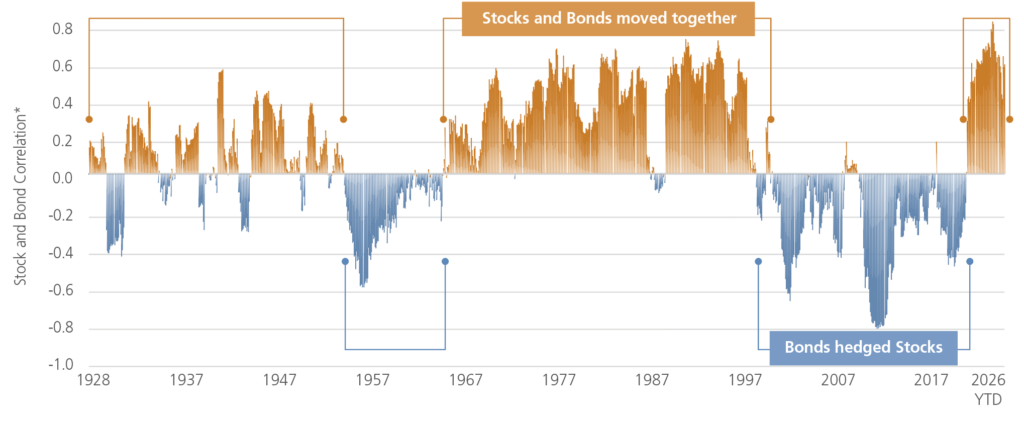
Source: LoCorr Fund Management and Morningstar Direct. Monthly data as of June 2026. *Average 2-yr rolling correlation between IA SBBI U.S. Large Stock TR Index and IA SBBI U.S. Long-Term Government TR Index, which transitioned to the Bloomberg U.S. Government Long Index on 12/31/75. Past performance is not a guarantee of future results.
How Can Inflation Lead to Positive Correlations?2
As the level of inflation increases, stocks and bonds have tended to move together, as shown below, undermining the diversification benefit of fixed income as a risk management tool. This makes it essential to explore asset classes that may behave differently from both equities and fixed income in inflationary environments. (These asset classes were not available to retail investors, or financial advisors, in the past when the 60/40 framework was established.)
Source: Morningstar Direct. Time period 1/1/86-6/30/26. Stocks represented by S&P 500 Index and bonds represented by Bloomberg U.S. Aggregate Bond Index. Past performance is not a guarantee of future results.
Adding a third asset class beyond equities and fixed income to create a 60/20/20 or 50/30/20 portfolio may strengthen diversification, making the portfolio resilient to a broader set of economic circumstances.
Not all alternatives are created equal. The fact is that many types of alternatives are highly correlated with equities and fixed income and therefore offer little safeguard from volatility. The table below shows that of Morningstar’s five most popular alternative categories, four had correlations to equities of 0.81 or greater in 2022, meaning they moved in the same direction as the overall market. The notable exception was the Systematic Trend category, which featured a low-to-negative correlation to stocks and bonds. The key to effective portfolio construction is to identify and combine strategies that behave distinctly.
| Morningstar Category Average | Returns 1/1/22-12/31/22 | Correlation** to S&P 500 Index |
| Equity Hedged*** | -9.55% | 0.92 |
| Multistrategy | -3.00% | 0.90 |
| Relative Value Arbitrage | -3.86% | 0.81 |
| Event Driven | -1.32% | 0.85 |
| Systematic Trend | 14.53% | -0.10 |
Source: Morningstar Direct. **Since common inception 4/1/07-12/31/22. ***Formerly the Morningstar Options Trading Category.
Returns are annualized for periods greater than one year. Performance data quoted represents past performance; Past performance does not guarantee future results.
The potential for inflation shocks remains higher than markets have been accustomed to. Rather than returning to the low and stable inflation environment that characterized much of the pre-pandemic era, the global economy appears increasingly susceptible to inflation volatility driven by supply chain disruptions, geopolitical tensions, structural labor shortages, and more expansionary fiscal policy. Building portfolios with strategies that can adapt to changing inflation regimes may help improve resilience when traditional diversification falls short.
With low-correlating strategies, the benefits of diversification are grounded in mathematics. Combining investments with low correlations may reduce overall portfolio risk, while improving the potential for more consistent risk-adjusted returns. The key is identifying truly differentiated sources of return, which begins with understanding how investments behave relative to one another. Fortunately, investors today have access to a broader range of investment strategies than ever before, making it easier to incorporate differentiated sources of return into traditional portfolios.
Diversification through low-correlated alternatives is not a trend but rather reflects an evolution of portfolio construction. The traditional stock-bond relationship has become less reliable, with stocks and bonds recently moving more or less in the same direction and bond yields remaining below historic averages. This environment underscores the need for investors to look beyond traditional markets for asset classes with low correlations to core investments and the potential to generate growth. Getting the allocation decision right may lead to improved stability and better risk-adjusted returns. In doing so, investors can position their portfolios for greater resilience and a higher likelihood of helping them achieve their long-term financial goals.
Searching for alpha and income diversification among strategies that remain highly correlated to stocks and bonds is not likely to be a winning strategy. Instead, consider low-correlating strategies that can potentially achieve both goals while also reducing overall portfolio risk.”
—Sean Katof, CFA®, CAIA®, Chief Investment Officer, LoCorr
[1] Russell Investments, “Alternative Diversifiers: Rethinking Diversification in Investment Portfolios” (2024), accessed March 17, 2025, https://russellinvestments.com/content/ri/us/en/
insights/russell-research/2024/09/alternative-diversifiers-rethinking-diversification-in-investmen.html.
[2] Boyu Wu, Beatrice Yeo, Kevin DiCiurcio, and Qian Wang. 2021. “The Stock/Bond Correlation: Increasing amid Inflation, but Not a Regime Change.” Vanguard Research, September.
The views and opinions expressed herein are those of LoCorr as of the date of publication and are subject to change without notice. The information is provided for informational and educational purposes only and should not be construed as investment advice or a recommendation to buy, sell, or hold any security. The information contained herein is believed to be reliable but is not guaranteed as to its accuracy, completeness, or timeliness. Any forward-looking statements are based on current expectations and assumptions and are subject to change based on market, economic, or other conditions. Actual results may differ materially from those expressed or implied. This material does not constitute an offer to sell or a solicitation of an offer to buy any security or investment product.
References to specific securities, sectors, asset classes, or investment strategies are for illustrative purposes only and should not be considered recommendations. There is no assurance that any investment discussed will remain in a portfolio or that any investment decisions made in the future will be profitable.
Click here for important disclosure and definition information.
Past performance is not a guarantee of future results. All investments involve risk, including the possible loss of principal. Investors should consider their own investment objectives, risk tolerance, and financial circumstances and consult with their financial, tax, and legal advisers before making any investment decision. One cannot invest directly in and index. Diversification does not assure a profit nor protect against loss in a declining market.
FOMO can undermine long-term discipline. In strong markets, the fear of missing out on equity gains can lead investors to abandon diversification...
Read MoreA portfolio of equities can be diversified by adding strategies with low correlation between the assets....
View Chart
When the market is turbulent, investors may be motivated to look for new ways to diversif...
Sign in to Read MoreThe Fund’s investment objectives, risks, charges, and expenses must be considered carefully before investing. The prospectus contains this and other important information about the investment company, and it may be obtained by calling 1.855.LCFUNDS, or visiting www.LoCorrFunds.com. Read it carefully before investing.
Mutual fund investing involves risk. Principal loss is possible. The Funds invests in foreign investments which involve greater volatility and political, economic and currency risks and differences in accounting methods. These risks are greater for emerging markets. Investing in commodities may subject the Funds to greater risks and volatility as commodity prices may be influenced by a variety of factors including unfavorable weather, environmental factors, and changes in government regulations. Investments in debt securities typically decrease in value when interest rates rise. This risk is usually greater for longer-term debt securities. Investments in Asset-Backed, Mortgage-Backed, and Collateralized Mortgage-Backed Securities include additional risks that investors should be aware of such as credit risk, prepayment risk, possible illiquidity and default, as well as increased susceptibility to adverse economic developments. Derivative contracts ordinarily have leverage inherent in their terms which can magnify the Fund’s potential for gains or losses through increased long and short position exposure. The Funds may access derivatives via a swap agreement. A risk of a swap agreement is the risk that the counterparty to the agreement will default on its obligation to pay the Funds. The Funds will incur a loss as a result of a short position if the price of the short position instrument increases in value between the date of the short position sale and the date on which an offsetting position is purchased. Investments in lower-rated and nonrated securities presents a greater risk of loss to principal and interest than higher rated securities. Underlying Funds are subject to management and other expenses, which will be indirectly paid by the Funds. The Fund’s portfolio will be significantly impacted by the performance of the real estate market generally, and the Funds may be exposed to greater risk and experience higher volatility than would a more economically diversified portfolio. Small and mid-sized companies may have limited product lines, markets or financial resources, and they may be dependent on a limited management group. There is no assurance that any hedging strategies utilized by the Funds will successfully provide a hedge to the portfolio’s holdings which could negatively impact Fund performance.
The LoCorr Funds are distributed by Quasar Distributors, LLC. © 2026 LoCorr Funds
If you have previously created a password protected account from LoCorr Funds, please sign in below to view gated materials.
Please enter your company email address. You will receive an email message with instructions on how to reset your password.
Send Recovery EmailThank you. A password reset email will be sent to you soon.